
TH Frank McKenna
Class of 2026
- Deputy Chair of Wholesale Banking TD Bank Group
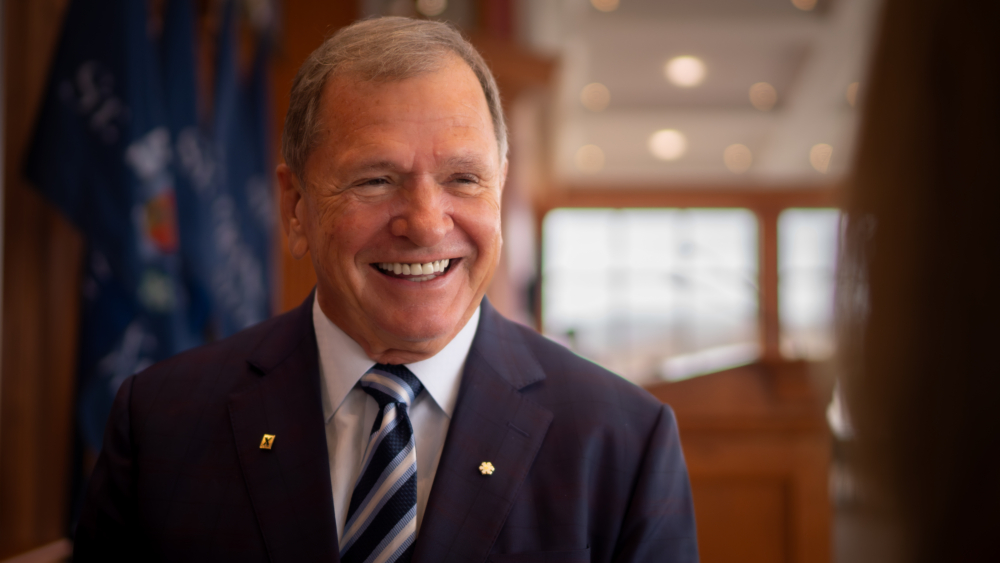
Dream big thoughts. Don’t ever let anybody else tell you what you can’t do. You decide for yourself how successful you’re going to be.
Frank McKenna was born in 1948 into a farming family in rural New Brunswick, one of eight children.
His father farmed from before dawn until late at night, seven days a week. His mother worked alongside him in the barn, prepared meals, and helped the children with their homework at night.
“We were poor. I mean, we were really poor, but we didn’t feel poor because we had food on the table,” Frank remembers.
The children wore hand-me-downs, and his mother sold hooked rugs for extra money.
With an already crowded house, Frank was sent next door to live with his widowed grandmother. She was a storyteller, a reader, and fiercely ambitious for her grandson. Her house held a decade’s worth of Reader’s Digest and a collection of Horatio Alger’s novels that Frank read again and again.
His grandmother expected a lot from him. Frank remembers coming home with five grades of 100 and one 99, only to have her ask him to explain the 99. “That kind of created a high bar,” he said.
Education mattered in the McKenna household. All eight children finished high school, and Frank became the first in his family to attend university. With no family money for tuition, he spent summers cutting pulp and building roads and relied on scholarships.
Frank attended St. Francis Xavier University for his undergraduate degree before scholarships took him to Queen’s University for graduate studies in political science and eventually to law school on a Beaverbrook Scholarship. “I don’t think I could have ever gone to university without scholarships,” Frank says. “Scholarships have been a central feature of my life.”
CAREER
Frank entered university without a clear idea of what he wanted to do. He had not grown up around lawyers, doctors, or businesspeople and, for a time, thought he might become a physical education teacher.
Then, while working for a newspaper, Frank had to drive each edition several hundred miles to a printing shop. With time to kill while the paper was being printed, he wandered into a nearby courthouse.
“I watched lawyers arguing their cases before a judge, and I said, wow, that seems interesting. I could do that.”
Frank finished near the top of his law school class and received offers from prestigious firms. Instead, with politics already in the back of his mind, he spread out a map of New Brunswick and looked for somewhere he thought he might eventually win an election. He chose the Miramichi region. Then something unexpected happened.
“Much to my horror and surprise, I absolutely loved practising law.”
Frank gravitated toward criminal trial work and became known for exhaustive preparation. He took calls in the middle of the night, went to jails and crime scenes, and eventually took on a high-profile murder case. After winning an acquittal, more major cases followed.
About a decade later, a provincial legislative seat opened in his riding. Frank loved practising law, but people he respected reminded him that another political opportunity might not come for 15 years. He took the chance.
On election night, national news organizations declared that Frank had lost. He responded by working his way through half a bottle of rum. Then his riding president rushed in with late poll results showing he had actually won.
A few years later, Frank became leader of the New Brunswick Liberal Party. Then came the 1987 provincial election, when the Liberals won all 58 seats in the legislature. “The look on my face, which I’ve seen, was one of total shock.”
Without a traditional opposition, Frank says his government had to be especially conscious of governing for everyone and resisting the arrogance that could come with such an overwhelming victory.
“It really made me a better politician and a better human being.”
Frank served as premier for 10 years. His government modernized infrastructure, created jobs, introduced kindergarten, and balanced the budget. But when Frank looks back, he is proudest of something harder to measure.
“What I’m proudest of, of everything, is that New Brunswickers got their pride back,” he says. “People got their swagger, people started to believe in themselves.”
Frank had promised voters he would serve for 10 years. While still popular, he kept that promise and stepped down.
When the Prime Minister asked him to become Canada’s Ambassador to the United States, Frank took the leap and came to love Washington.
He developed a personal rapport with President George W. Bush and worked through difficult cross-border disputes.
WHAT I'VE LEARNED
Across law, politics, diplomacy, and business, Frank has come back to the same lesson he first learned growing up on the farm: hard work matters.
“I’ve always thought that a lot of my success was the triumph of hard work over ability,” he says. “Honestly, I’m sure there were smarter kids, but I outwork most kids.”
Some of his hardest lessons came during his years as premier. Faced with deep cuts in federal transfers, Frank’s government had to freeze wages and lay off thousands of people. He remembers coming home one night overwhelmed by the pain those decisions would cause.
His wife, Julie, reminded him that he had taken the job and had a responsibility to make the difficult decisions that came with it.
“That kind of put some steel in my spine,” Frank says. “I’m not so much afraid of other people’s reaction. I’m afraid of my own.”
From then on, Frank became more willing to make difficult choices and accept their consequences. It reinforced a belief that has followed him throughout his career. “If you leap, the net will find you.”
Frank’s connection to the Horatio Alger Association brings his story back to where it began. Long before he knew there was an organization bearing the name, he was a boy in his grandmother’s house reading Horatio Alger’s novels over and over.
“In some ways, my life is a Horatio Alger book,” Frank says.
Horatio Alger’s stories showed a young boy growing up without wealth or privilege that his circumstances did not have to determine what came next. They were about “being poor but not being condemned to poverty, about having the ability to make life better for me and/or my family and/or other people in society.”
Decades later, Frank had an opportunity to create for others the kind of opportunity scholarships had given him. He donated $20 million to St. Francis Xavier University to establish a major scholarship program. It was a fitting investment for someone who knows he likely would never have attended university himself without financial support.
That experience is part of why the work of the Horatio Alger Association resonates so strongly with him.
“I’m living proof of the fact that if you make scholarships available to young people, they can go on to repay society many times over,” he says.
For the young people receiving those scholarships today, Frank’s advice reflects the ambition his grandmother encouraged in him all those years ago. “Dream big thoughts. Don’t ever let anybody else tell you what you can’t do. You decide for yourself how successful you’re going to be.”