
LCol Simon Mailloux
Class of 2026
- Lieutenant Colonel and Commanding Officer, 1st Battalion of the Royal 22nd Regiment Canadian Armed Forces
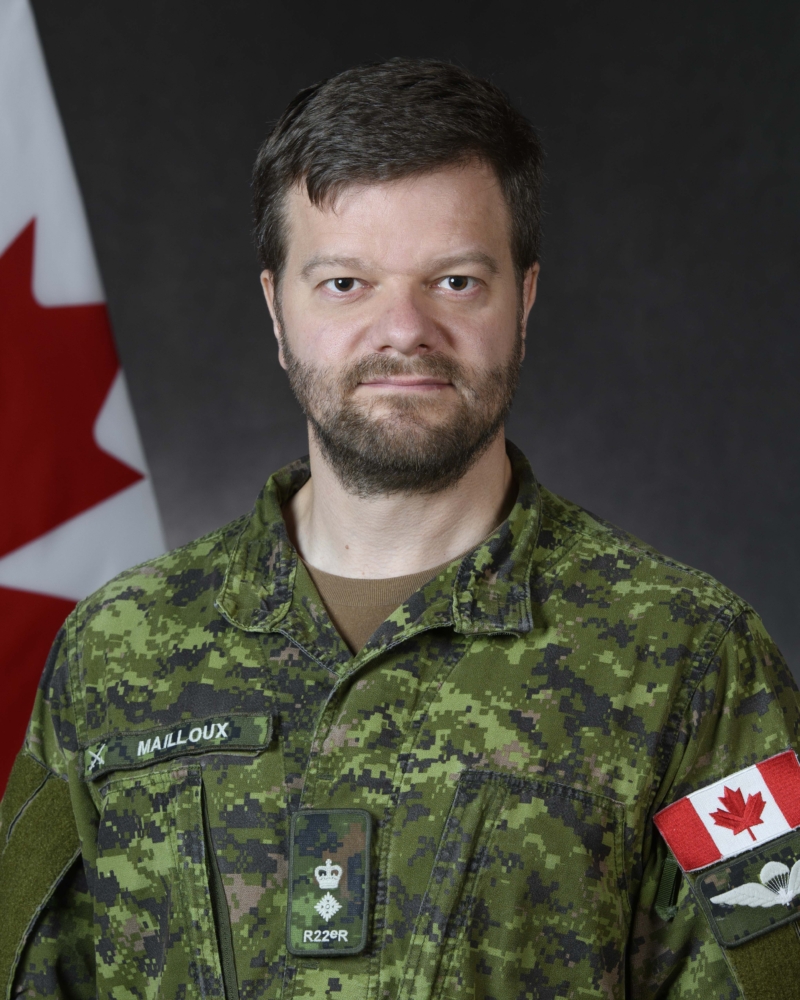
You don’t know your limit. You’ve never tested it. You can go further. You can keep going. There is always a bit more in you. Physically, mentally, and in the hard work you put in.
Simon grew up in Quebec City, the son of a cook and a waitress. There was no blueprint for what he would become, only the example of a father who got up every single morning to go to work, no matter what. “He was a man of few words,” Simon says. “But his work ethic stuck with me.”
Nobody in Simon’s family had gone to university. He would be the first. He enrolled not for the diploma, but for his dream to become an officer in the Canadian Armed Forces, and that path required a degree. The pull toward service to his country had begun years earlier. At eleven, he showed up to join the Air Cadets and was turned away. Too young, they said, come back later. He came back.
“I was hooked,” he says. He has been wearing the uniform ever since. More than 25 years later, that pull has not let go.
CAREER
Simon attended the Royal Military College in Kingston, where he met many of the friends he still has today. He commissioned as an infantry officer with the Royal 22e Régiment, one of the most storied units in the Canadian Armed Forces.
In 2007, Simon deployed to Afghanistan as a platoon commander in Operation Athena. That November, his vehicle struck an improvised explosive device.
The explosion tore the vehicle apart from underneath. It ejected Simon and several other soldiers. It took his leg. It also killed his signaller, Corporal Michel Lévesque, and his medic, Corporal Nicolas Beauchamp. They were not the first soldiers that were lost on that tour. They were the second and third.
Simon doesn’t remember the blast itself. He woke up in Germany, disoriented, a piece of himself gone. “You check for parts,” he says quietly. “You check that everything is working in order, and then you figure out something’s missing. It’s a really weird feeling. You think it’s a nightmare. You think it’s a way or not.”
He chose differently.
When he left the hospital, he was in a wheelchair. And he noticed people looking at him differently – not with cruelty, but in a way that made him feel like his story was over. That look didn’t match who he knew he was. He was not a patient. He was not a story that was over. He was a soldier. And he wanted his dream back.
No Canadian amputee had ever returned to operational service as an infantry officer. The Army, just beginning to give Afghan-injured veterans the chance to try, set one condition: meet the standard. There would be no accommodation for the standard itself. Simon put in the work. He met it. In 2009, he redeployed by choice to Afghanistan as a staff officer in brigade headquarters – back on the very ground where he had nearly died.
He has since deployed to Ukraine to help train the Ukrainian Armed Forces and served on domestic operations, including flood response in Montreal. Tonight, he is deployed to Latvia in support of NATO – his fourth tour. He didn’t have to go. He chose to go. He fought to go.
BEYOND THE UNIFORM
Beyond his military career, Simon has become one of Canada’s most outspoken advocates for wounded soldiers. In 2017, he served as Team Canada co-captain at the Invictus Games in Toronto, opening the Games with his family in the stands. He competed in track and field. “I was horrible at it,” he says with a laugh. “But you do it anyway.” That sentence, said about a race, is also the story of his life. He continues to support Soldier On, the charity that first welcomed him into adaptive sport.
Simon has told his story to thousands. He does it deliberately – for the soldiers who don’t have the words or the platform to speak publicly about what happened to them in their service to our country. “The more people know about us,” he says, “the harder it is to hide us, and the harder it is to push us out of the forces.” He was the proof of concept. By going first, Simon helped open the door for every injured soldier who came after him.
WHAT I'VE LEARNED
Simon doesn’t measure success in rank or accolades. He measures it in mornings. “Success is every day for me,” he says. “I’m still alive. I could have died. I should have died, I think.” A minute before the bomb, he had switched positions with his signaller, Michel. He carries that moment with him – what it gave him and what it cost. Every day since has been, in his mind, borrowed time. He spends it wisely.
“Every minute for me is a given extra one. So being out here in the rain with people in the mud, it’s a gift. I’m very proud of it. I wouldn’t change it for anything.”
To young Canadians and the Scholars the Horatio Alger Association of Canada exists to support – the ones who started from behind, who are still finding their footing – Simon’s message is short: “You don’t know your limit. You’ve never tested it. You can keep going. There is always a bit more in you.” He knows it because he lived it, in a hospital bed in Germany, with one leg and a choice to make.
Joining the Horatio Alger Association of Canada felt right to Simon because it is an organization that doesn’t just celebrate the ones who started ahead, it reaches toward the ones who started with less, who faced harder roads, and who kept going anyway. He recognizes those people. He was one of them. “Canada has a heart,” he says. “We should be giving back to the youth and making sure they have the best kickoff that we can give them.”
Asked what he is most proud of, Simon turns the conversation away from himself. He talks about the Canadians who are still deployed, still in the rain, still putting their lives on the line so the country can be at its best. “Their work is critical,” he says. “And they’ll keep at it for many, many years.”
Simon’s story begins with a boy in Quebec City whose family had little, who showed up too early to the cadets and was sent home but came back anyway. It runs through battlefields and hospital rooms, through grief and grit. His story is one of the long, hard work of becoming himself again. And it arrives here: a Lieutenant Colonel on his fourth tour, standing in front of young Canadians who are still figuring out what they’re made of. He already knows what he would tell them, he’s been telling them his whole life. There is always a bit more in you.